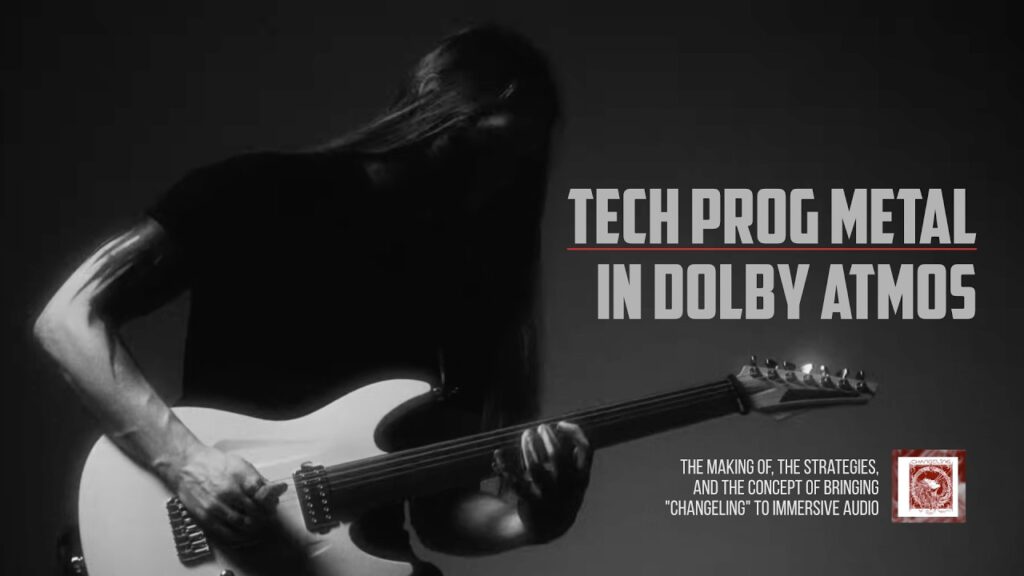
The self-titled debut by Changeling is not simply another entry in the technical progressive death metal canon — it is a deliberate rethinking of what an extreme metal album can be in both musical and spatial terms. Conceived by Berlin-based guitarist and producer Tom “Fountainhead” Geldschläger, the record operates as a 60-minute conceptual journey, structured around a psychedelic transformation that unfolds across ten interconnected movements.
Musically, the album expands the vocabulary of tech-prog death metal far beyond its usual parameters. Hyper-precise riffing and virtuosic rhythmic complexity coexist with orchestral writing, jazz-fusion textures, world-music instrumentation, and microtonal experimentation. The result is less a collection of songs than an evolving sonic environment, populated by fretless guitars, layered choirs, acoustic instruments, and the contributions of dozens of guest musicians.
What truly distinguishes the album, however, is not just its compositional ambition but the way it was engineered to be experienced. From the outset, Changeling was written not only for stereo playback but specifically for immersive spatial audio. Its Dolby Atmos mix is not a decorative afterthought — it is integral to the artistic concept.
In Dolby Atmos, sound is no longer confined to left and right channels; it occupies three-dimensional space. Instruments can move, surround, and envelop the listener, transforming listening from passive reception into spatial immersion. The Atmos version of Changeling uses this format to position orchestral layers, swirling fretless lines, and dense rhythmic structures around the listener, effectively turning the album into an acoustic environment rather than a flat recording.
This spatial approach aligns naturally with the album’s thematic focus on altered perception and psychological transformation. The music does not merely describe disorientation and expansion — it physically enacts them through sound placement. Narrative becomes architectural. Composition becomes geography. Listening becomes exploration.
In this sense, Changeling represents a broader shift in how extreme metal can function as a medium. Traditionally, the genre has pushed limits through speed, complexity, and technical execution. Here, the frontier is dimensionality. By treating space itself as a compositional element, the album reframes heaviness and intricacy as immersive phenomena rather than purely musical ones.
The significance of this move is substantial. If technical death metal has long been about expanding what musicians can play, Changeling suggests the next evolution may be about expanding how music can exist in space. Its Dolby Atmos mix is not just a technological enhancement — it is a statement that the future of progressive metal may be as much architectural as it is musical.
In short, Changeling is not merely heard.
It is entered.
You may also like
-
Its name implies no real Player should even think about it for a split second: Loopy Pro!
-
Seattle! Grunge Vibes & Guitar Culture
-
Audeze LCD-S20 – Precision headphone monitoring for a perfect “pocket”, intonation, and no bleed!
-
The Headphone Dilemma! For Recording, Mixing, Mastering – The Audeze MM-100 is the budget friendly solution.
-
Fiedler Audio Launches Mastering Console 2.0 — A truly game-changing Major Upgrade to Dolby Atmos Mastering