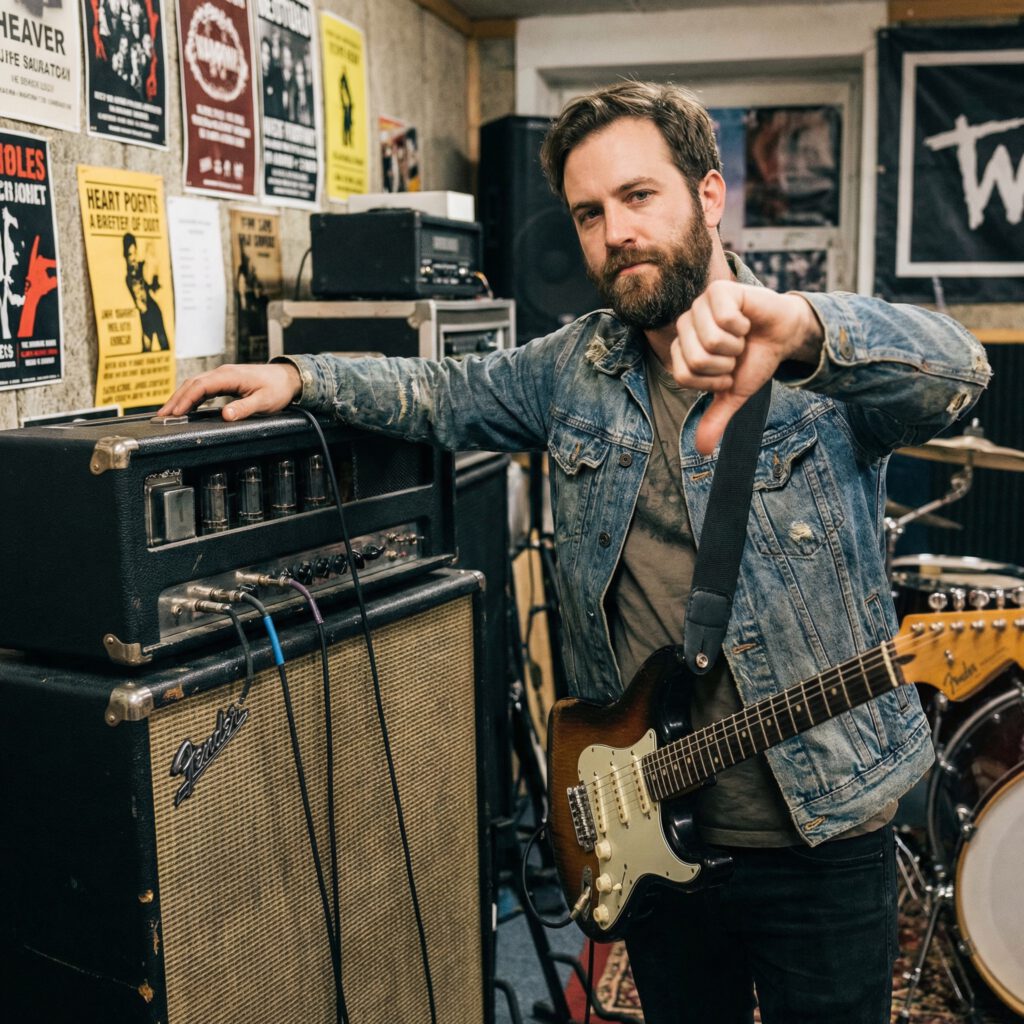
The fixation on amp tones, being totally obsessed with getting “that” tone from “this” amp. That’s barking up the wrong tree. What is this amp? Who actually define that this is “this” amp’s tone? And even more important: Who the eff cares! The world always listens to the microphone, anyways!
The idea that a guitar amplifier is the key to a “great guitar sound” is one of the most persistent myths in modern music culture. Walk into any music store or browse any online forum, and you’ll quickly encounter passionate debates about tubes versus solid state, boutique versus mass-produced, vintage versus modern. Yet this obsession rests on a flawed assumption: that the amplifier is the defining ingredient of guitar tone. In reality, it is only one variable in a complex, interconnected system. A great guitar sound does not come from an amplifier alone—often, it does not even primarily come from the amplifier. It emerges from an entire chain of influences, many of which are far more decisive.
At the most fundamental level, tone begins with the player. Touch, timing, phrasing, pick angle, finger pressure, vibrato technique, and rhythmic feel shape the sound long before any electronic component enters the signal path. Two musicians playing the same guitar through the same amplifier can sound radically different. This is not a subtle effect—it is often dramatic. The way a note is attacked, sustained, muted, or bent determines its harmonic content and dynamic contour. An amplifier can only amplify what already exists. It cannot manufacture musical intention.
Next comes the instrument itself. Wood resonance, pickup design, string gauge, scale length, bridge construction, and setup all shape the raw signal. Even small adjustments—pickup height, string age, or tuning stability—alter frequency balance and sustain. The amplifier does not generate these characteristics; it reacts to them. Change the guitar, and the same amplifier produces a completely different tonal result. This alone demonstrates that tone is not located in any single piece of gear.
Beyond the instrument lies the signal chain. Effects pedals, buffers, cables, power supplies, and routing order can drastically reshape sound. Compression alters dynamics, overdrive changes harmonic structure, equalization reshapes frequency emphasis, modulation affects spatial perception, and time-based effects define depth and atmosphere. Each stage transforms the signal before it ever reaches the amplifier. By the time amplification occurs, the sonic identity may already be largely established.
The environment is another powerful factor. In live performance, room acoustics often dominate what the audience actually hears. Reflections, absorption, crowd density, stage positioning, and speaker direction all influence perceived tone. A guitar sound that seems full and balanced on stage may become thin, boomy, or indistinct in a different venue. The amplifier does not control this interaction—physics does.
Recording adds yet another layer of transformation. Microphone selection, placement, and angle can change tone more dramatically than switching amplifiers. A slight shift in mic position can alter brightness, low-end response, and perceived aggression. After that, preamps, equalization, compression, reverb, stereo placement, and mastering processing further sculpt the sound. By the time a listener hears a recorded guitar, the signal has been reshaped repeatedly. The amplifier is only one historical step in a long chain of reinterpretation.
Even monitoring systems affect tone perception. Studio monitors, headphones, PA systems, streaming compression, and consumer playback devices all color the final result. A guitar sound that seems perfect in one listening environment may feel completely different in another. Listeners never hear the amplifier in isolation—they hear a reproduced version shaped by multiple layers of translation.
Psychology also plays a role. Expectations influence perception. If someone believes a particular amplifier is legendary, they may perceive its sound as inherently superior. But perception is not purely acoustic; it is cognitive. Branding, reputation, visual aesthetics, and cultural narratives all shape how tone is evaluated.
None of this means amplifiers are irrelevant in a literal sense. They clearly influence gain structure, frequency emphasis, headroom, and dynamic response. But influence is not dominance. The amplifier does not define tone independently—it participates in a network of dependencies. Its role is interactive rather than absolute.
A more accurate way to understand guitar tone is as a system of equations with many variables: player, instrument, setup, signal chain, environment, recording process, and playback context. Change any one variable and the result changes. The amplifier is simply one coefficient among many.
The persistent belief that a single piece of equipment can guarantee great tone reflects a desire for simple solutions. It is easier to buy a new amplifier than to refine technique, experiment with mic placement, or understand acoustic behavior. But great guitar sound is not purchased—it is constructed, shaped, and negotiated across an entire sonic ecosystem.
In the end, the amplifier does not create greatness. It reveals, colors, and transmits what already exists within a much larger system.
A truly great guitar sound is not the product of one machine, but the outcome of a complex collaboration between human expression, physical materials, electronic processing, acoustic space, technological mediation, and a player’s creative decisions. Because all the above is just up the choice of a human being – The amplifier is merely one voice in that conversation—not the author of it.
You may also like
-
Kemper released the next level of its Profiling Technology for the Most Organic Amp Tones Ever Captured
-
Nerd Alert: Playing “A Church in Ruins” by Lera Lynn and T. Bone Burnett
-
Changeling – The Tech Prog Death Metal Album Monster. Also in Dolby Atmos
-
Stop Worshipping the Guitar Amp
-
New tone concepts for Nylon Guitars – Creative FX, rethink your live performances