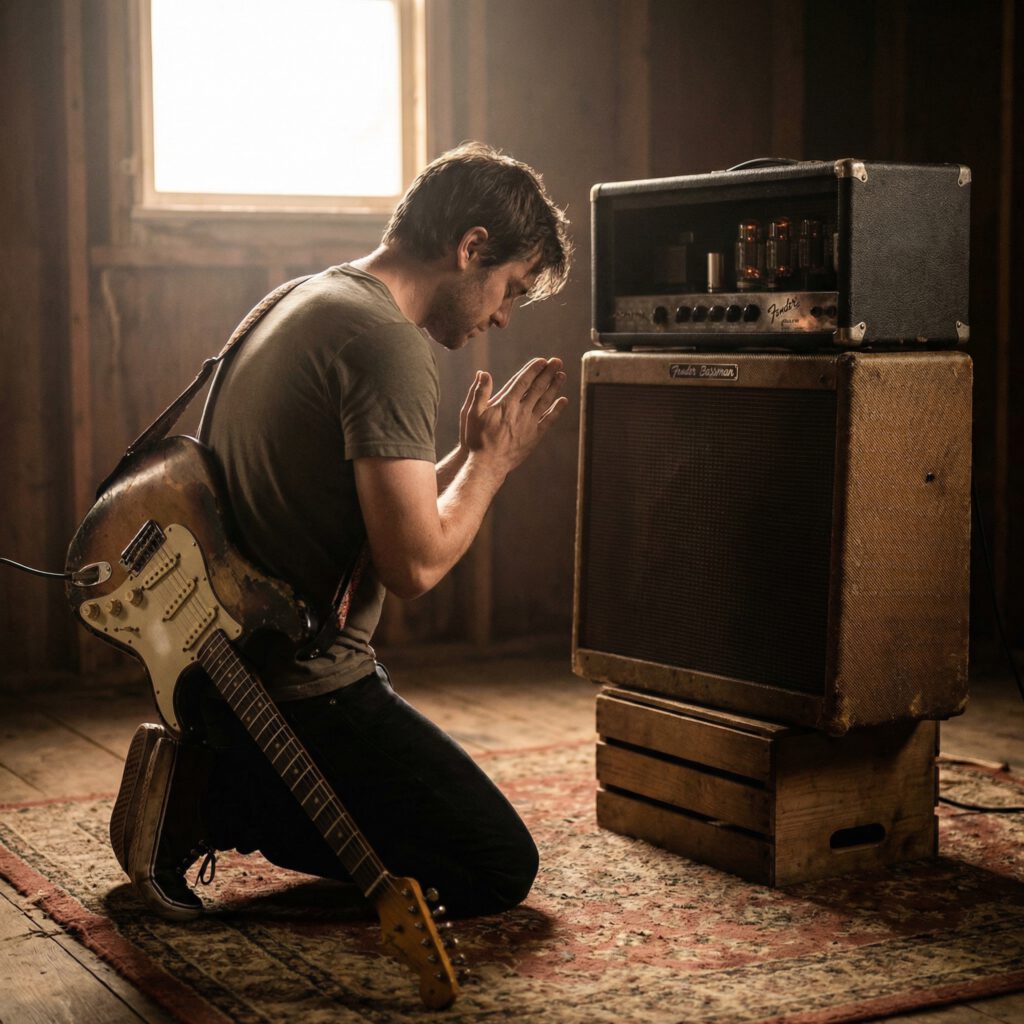
Guitar players love to talk about amplifiers as if they were sacred objects — glowing tubes, boutique circuitry, vintage magic. Entire identities are built around them. People argue about them with religious intensity. And yet, the obsession rests on a fundamental misunderstanding:
A guitar amp is not the source of a great guitar sound.
It’s just one variable in a massive tonal equation.
That might sound heretical in gear culture, but it’s acoustical reality.
Tone starts in the hands. Always has. Pick attack, timing, phrasing, muting, vibrato — these shape the harmonic fingerprint of every note before electricity even enters the picture. Two players using identical rigs will still sound unmistakably different. Why? Because the signal being amplified is already different. The amp doesn’t create expression — it magnifies it.
Then there’s the guitar itself. Pickup design, string condition, scale length, setup, and even how hard the player frets all change the raw signal. Swap instruments, keep the amp, and the sound changes dramatically. That alone should end the myth of amp supremacy.
But we’re not done.
Pedals reshape gain structure, frequency balance, and dynamics before the signal even reaches the amp. Cables load pickups. Buffers alter impedance. Signal order changes response. By the time the amplifier receives anything, it’s already been sculpted.
And what about the room? Live sound is ruled by acoustics — reflections, absorption, speaker direction, crowd density. The audience hears the space as much as the gear.
Recording? That’s an even bigger transformation. Microphone choice and placement can alter tone more radically than switching amplifiers. Then come preamps, EQ, compression, spatial processing, mastering. The sound people recognize from records is a heavily interpreted version of the original signal chain.
And after all that — playback systems color everything again.
So where, exactly, is the amplifier’s supposed dominance?
It isn’t that amps don’t matter. Of course they do. They shape response, headroom, breakup character, and frequency contour. But they do so within a dense network of influences. They are participants, not rulers.
The enduring fantasy of the “magic amp” is really about convenience. It’s comforting to believe tone can be purchased in a box. Technique is harder. Acoustic understanding is harder. Critical listening is harder. Systems thinking is harder.
But great guitar sound has never been a product — it’s an outcome.
An emergent result of human touch, physical design, electronic shaping, acoustic interaction, and technical mediation.
The amplifier doesn’t create greatness.
It reveals whatever greatness — or weakness — is already there.
Treating it as the ultimate source of tone is like crediting a camera lens for a photographer’s vision. It matters. It influences. But it does not define.
The sooner guitar culture stops worshipping amplifiers, the sooner players can focus on the only thing that has always mattered most:
The sound they put into the system in the first place.
You may also like
-
Changeling – The Tech Prog Death Metal Album Monster. Also in Dolby Atmos
-
The wrong conversation – for decades! Amps don’t matter, at least not that much!
-
New tone concepts for Nylon Guitars – Creative FX, rethink your live performances
-
“Don’t divide by Zero” 😀 – Why Null Tests Fail for Amp Captures
-
Fiedler Audio Breaks New Ground in Immersive Audio Production and Mastering