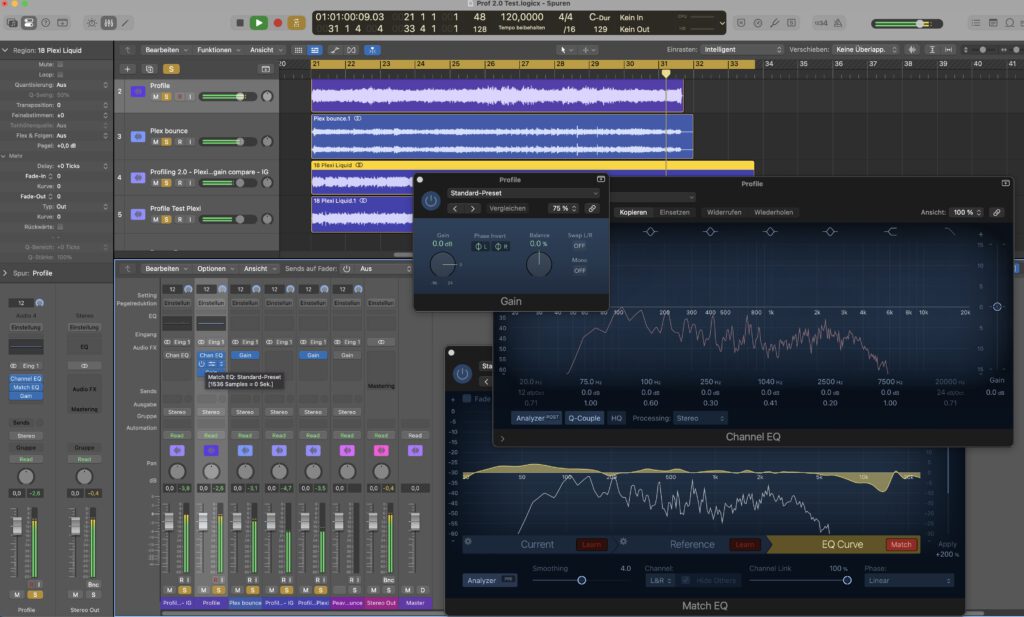
At first glance, a null test for evaluating the accuracy of amp captures appears to have a solid scientific foundation. In practice, however, it does not tell us what many people think it tells us.
You can verify this with your own ears. Given the remarkable sonic accuracy of modern amp-capturing devices, you may have wondered why null tests on YouTube almost always sound disturbing: scratchy, noisy, and oddly aggressive — yet still at a surprisingly high signal level. You may also have noticed a recurring pattern: as soon as the guitar strings decay, the remaining clean tone suddenly blooms and becomes even louder in the null signal.
This behavior isn’t evidence of poor capture quality. It’s the result of extremely small phase deviations between the original amp signal and the capture — often just fractions of a millisecond.
When listening to the original amp and the capture separately, the human ear is effectively blind to such tiny timing differences. They do not degrade the perceived tone, feel, or realism in any meaningful way. In real musical contexts, these deviations are completely inaudible.
A null test, however, is brutally unforgiving. It exaggerates microscopic phase differences and converts them into audible artifacts: scratching noises, swirling remnants, and unnaturally blooming decays that don’t actually exist in either signal on its own. What you’re hearing in a null test is not “what the capture got wrong,” but the mathematical residue of two almost-identical signals failing to cancel perfectly.
The immense sensitivity to these small phase deviations that the ear cannot hear, will easily obscure truly relevant sound differences, such as potential frequency response or dynamics deviations. The ear notice these differences very easily in a regular A/B comparison, while the null test only produces noises.
The Takeaway
The unavoidable conclusion is this: every amp-capturing device fails a null test, particularly on clean sounds — and that failure tells us very little about how accurate, musical, or usable the capture actually is.
Null tests are excellent tools in some areas of audio engineering. Amp captures are not one of them.
You may also like
-
Its name implies no real Player should even think about it for a split second: Loopy Pro!
-
Seattle! Grunge Vibes & Guitar Culture
-
Audeze LCD-S20 – Precision headphone monitoring for a perfect “pocket”, intonation, and no bleed!
-
The Headphone Dilemma! For Recording, Mixing, Mastering – The Audeze MM-100 is the budget friendly solution.
-
Fiedler Audio Launches Mastering Console 2.0 — A truly game-changing Major Upgrade to Dolby Atmos Mastering